
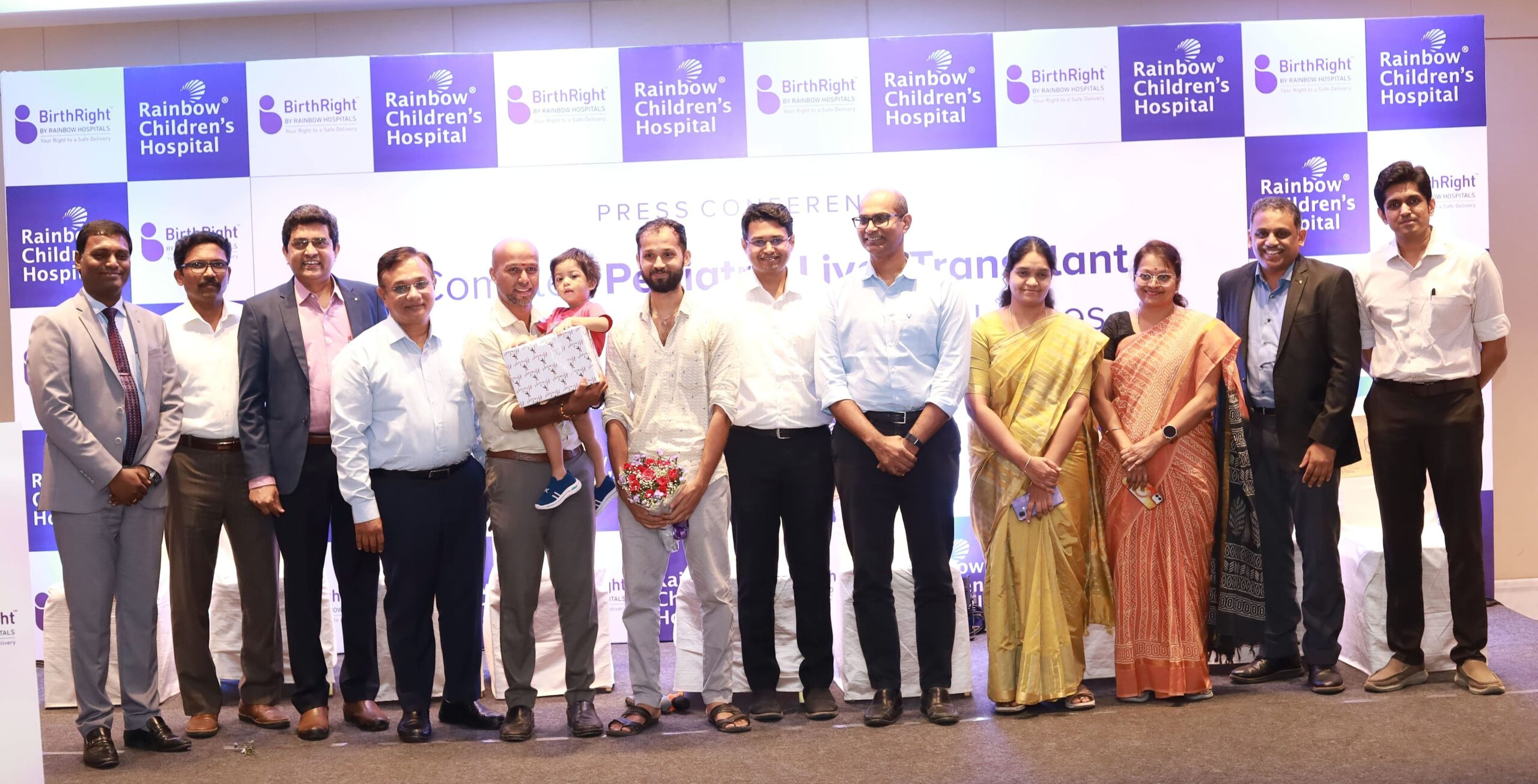
3-Year-Old Child Undergoes Successful Liver Transplant at Rainbow Children’s Hospital for Rare Langerhans Cell Histiocytosis
Multidisciplinary team in Chennai manages rare systemic disease, severe liver dysfunction and congenital urinary abnormality before successful living donor liver transplant
Chennai: Doctors at Rainbow Children’s Hospital, Chennai, have successfully performed a living donor liver transplant on a 3-year-old child diagnosed with Langerhans Cell Histiocytosis (LCH), a rare systemic disorder that had caused significant liver dysfunction.
The complex case required coordinated treatment involving pediatric hepatology, liver transplantation, hemato-oncology, nephrology, urology, pediatric surgery, anesthesiology and pediatric intensive care. Before the liver transplant could be performed, the medical team had to control the underlying disease, manage severe liver dysfunction, treat recurrent urinary tract infections and correct a congenital urinary abnormality.
Rare LCH Complicated by Severe Liver Dysfunction
The child was initially brought to Rainbow Children’s Hospital with jaundice. Detailed investigations revealed Langerhans Cell Histiocytosis (LCH) with significant liver involvement and dysfunction.
Given the severity of the liver disease, doctors initially focused on controlling the underlying LCH and improving the child’s overall condition before proceeding with transplantation.
Chemotherapy was initiated, but because the child’s liver was already severely compromised, treatment had to be carefully adapted. The child initially received low-dose chemotherapy, which produced only a partial response. Subsequently, newer targeted therapy resulted in a good response in controlling the LCH.
Recurrent Urinary Infections Revealed a Second Major Challenge
During chemotherapy, the child developed recurrent urinary tract infections (UTIs). Rather than treating the infections as an isolated complication, the multidisciplinary team investigated the underlying cause.
Evaluation by the Pediatric Nephrology and Urology teams identified congenital vesicoureteric reflux (VUR)—a condition in which urine flows backwards towards the kidneys and can increase the risk of recurrent urinary infections.
Because the child was being considered for liver transplantation and minimizing infection risk was critical, the urinary abnormality needed to be addressed before the transplant.
The child therefore underwent ureteric reimplantation surgery to correct the congenital abnormality. A temporary stent was also placed to support the urinary system during recovery and the transplant process.
Multidisciplinary Approach Made the Transplant Possible
The child’s treatment required a carefully staged approach, with each medical intervention planned around the next.
A multidisciplinary team at Rainbow Children’s Hospital comprising Pediatric Nephrologists, Pediatric Surgeons, Urologists, Hepatologists, Pediatric Transplant Surgeons, Pediatric Hemato-Oncologists, Pediatric Intensivists and Anesthesiology specialists worked together to stabilize the child and prepare him for transplantation.
Once the urinary abnormality had been corrected and the child was medically stabilized, the liver transplant was successfully performed approximately three weeks later.
Living Donor Liver Transplant Using Father’s Liver
The child underwent a living donor liver transplant, receiving the left lateral segment of his father’s liver after detailed donor evaluation confirmed that he was a suitable donor.
The transplant was performed by Dr. Mettu Srinivas Reddy, Group Director – Department of Liver Transplantation & HPB Surgery, Rainbow Children’s Hospital, Chennai, along with Dr. Somashekara H R, Senior Consultant – Pediatric Hepatology & Liver Transplantation, Rainbow Children’s Hospital, Guindy, supported by the multidisciplinary medical team.
The approximately 10-hour transplant procedure involved transplantation of the left lateral segment of the donor liver.
Following surgery, the child was closely monitored for around eight weeks. He subsequently continued disease-directed chemotherapy for LCH and completed four additional rounds of treatment.
Follow-up evaluations showed no evidence of Langerhans Cell Histiocytosis, while the recurrent urinary infections had also resolved.
Doctors Highlight Importance of Coordinated Pediatric Care
Speaking about the complex case, Dr. Somashekara H R, Senior Consultant – Pediatric Hepatology & Liver Transplantation, Rainbow Children’s Hospital, said:
“This was an exceptionally complex case because we were not dealing with a single problem. We had to manage a rare systemic disease with severe liver involvement, while also dealing with the limitations that the liver dysfunction placed on chemotherapy. When recurrent infections emerged, we had to identify and correct the underlying urinary abnormality before the child could proceed to transplant. Each decision had to be carefully coordinated with the next.”
He added that collaboration between the hemato-oncology, hepatology and liver transplant, nephrology and urology teams helped the hospital address the different challenges in a planned and coordinated manner.
Dr. Mettu Srinivas Reddy, Group Director – Department of Liver Transplantation & HPB Surgery, Rainbow Children’s Hospital, said that transplantation in a young child with significant liver involvement and multiple medical complications required meticulous planning.
He emphasized that stabilizing the child, controlling infections and correcting the congenital urinary abnormality were important steps before transplantation.
Addressing the Urinary Abnormality Before Transplant
Dr. Prahlad N, Senior Consultant – Pediatric Nephrology & Kidney Transplant, Rainbow Children’s Hospital, explained that recurrent urinary infections added another significant challenge to the treatment journey.
The medical evaluation identified gross vesicoureteric reflux, and managing the reflux and preventing further infections became an important part of preparing the child for liver transplantation.
Dr. Nandhini G, Senior Consultant – Pediatric Surgeon and Urologist, Rainbow Children’s Hospital, Guindy, said that further evaluation confirmed congenital vesicoureteric reflux.
The team performed ureteric reimplantation surgery with stent placement, followed by close monitoring. Correcting the urinary abnormality helped reduce the risk of further infections and allowed the child to proceed to liver transplantation after recovery.
Rainbow Children’s Hospital Chennai: Complex Pediatric Transplant Care
The case highlights the importance of multidisciplinary pediatric care in complex liver transplantation, particularly when a child has an underlying systemic disease and additional medical complications.
The successful treatment involved sequential management of Langerhans Cell Histiocytosis, liver dysfunction, chemotherapy-related challenges, recurrent urinary tract infections and congenital vesicoureteric reflux, followed by living donor liver transplantation and continued disease-directed therapy.
The child continues to remain under follow-up, with subsequent evaluations showing no evidence of LCH and resolution of recurrent urinary infections.
Medical Team
- Dr. Mettu Srinivas Reddy – Group Director, Department of Liver Transplantation & HPB Surgery
- Dr. Somashekara H R – Senior Consultant, Pediatric Hepatology & Liver Transplantation
- Dr. Prahlad N – Senior Consultant, Pediatric Nephrology & Kidney Transplant
- Dr. Prasanna Gopal – Pediatric Transplant Surgeon
- Dr. Nandhini G – Senior Consultant, Pediatric Surgeon and Urologist
- Dr. Karthik Narayanan R – Consultant, Pediatric Intensive Care
- Dr. Nataraj P – Consultant, Pediatric Intensive Care
- Dr. Meena Sivasankaran – Consultant, Pediatric Hemato-Oncology
- Dr. Sathish Chander – Lead, Anesthesiology